

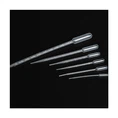
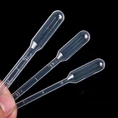
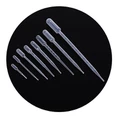
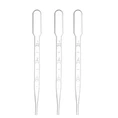
The working principle of a Pasteur pipette is primarily based on gravity-driven flow and capillary action, combined with the manual control of air pressure differentials to facilitate the aspiration and transfer of liquids.
Manual Suction Control: The operator applies suction to the wide end of the pipette-either orally or using an auxiliary rubber bulb-to create negative pressure within the tube, thereby drawing liquid into the fine tip.
Gravity-Driven Dispensing: Once suction is released, the liquid flows out naturally under the influence of gravity; dispensing can also be assisted by gently squeezing the pipette body or tilting the receiving vessel.
Droplet Reproducibility: By calibrating the ratio of "drops per milliliter," the pipette enables approximate quantitative transfer, making it suitable for procedures that require repeatability rather than absolute precision.
Sterility Assurance: Prior to use, a cotton plug can be inserted into the wide end and sterilized to prevent microbial contamination during handling-a practice particularly common in microbiological experiments.