

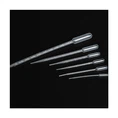
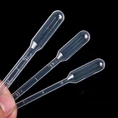
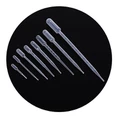
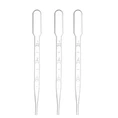
In the microscopic realm of the laboratory and the intricate operational settings of medical practice, the Pasteur pipette serves as a silently dedicated "tiny assistant." Despite its slender form, it plays an indispensable role in critical processes-such as sample handling and liquid transfer-lending precision and reliability to the smooth execution of scientific research and medical work.
Pasteur pipettes are typically crafted from transparent plastic-a design choice that is by no means accidental.
The transparent material allows users to clearly observe the state, color, and volume of the liquid within the tube; whether dealing with sample solutions in an experiment or biological fluids-such as blood or urine-in a medical test, everything remains instantly visible. This feature significantly enhances both the accuracy and controllability of the operation.
The pipette features a long, slender, and uniform body, terminating in a tapered tip at one end and fitted with a rubber bulb at the other.
The tapered tip allows for easy insertion into various vessels-such as test tubes and petri dishes-facilitating the convenient aspiration of liquids.
Meanwhile, the rubber bulb boasts excellent elasticity and sealing properties. By gently squeezing and releasing the bulb, users can precisely control the volume of liquid drawn in and dispensed-an ingenious design that embodies the perfect fusion of scientific principle and practical utility.